
Global Anti-Carbonation Coatings Market Outlook 2026-2036: Strategic Trends, Innovation Drivers & Growth Opportunities
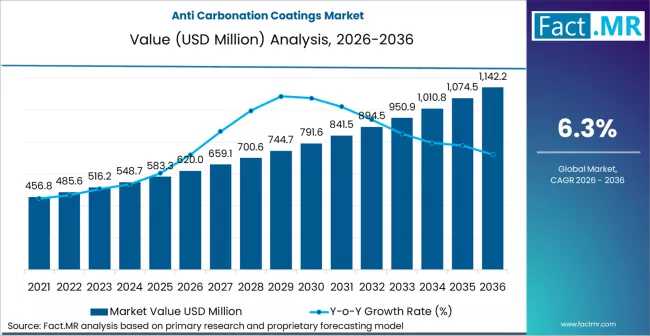
Anti Carbonation Coatings Market
Anti-Carbonation Coatings Market Expected to Reach US$ 5.37 Billion by 2036, Expanding at 5.8% CAGR
ROCKVILLE, MD, UNITED STATES, February 16, 2026 /EINPresswire.com/ -- The global anti-carbonation coatings market is entering a period of significant structural growth, with its valuation projected to rise from US$ 3.05 billion in 2026 to US$ 5.37 billion by 2036. Driven by the critical need for infrastructure longevity and the accelerating modernization of global transportation systems, the market is set to expand at a CAGR of 5.8%, fundamentally reshaping how concrete assets are preserved against environmental degradation.Request for Sample Report | Customize Report |purchase Full Report - https://www.factmr.com/connectus/sample?flag=S&rep_id=14237
Anti-Carbonation Coatings Market Snapshot
Market size 2026? US$ 3.05 Billion.
Market size 2036? US$ 5.37 Billion.
CAGR? 5.8% (2026–2036).
Leading product segment(s)? Grilling & frying accessories command 45.1% share; Baking accessories hold 25.6% share.
Leading material type? Disposable materials lead with a 58.1% market share.
Leading end use? Residential sector dominates with 51.9% share.
Key growth regions? North America (Leading), Asia Pacific (Fastest-growing), and Europe.
Top companies? AkzoNobel, BASF SE, Sherwin-Williams, PPG Industries, Jotun, Hempel, and Sika AG.
Market Momentum (YoY Path)
The trajectory of the anti-carbonation coatings market shows a consistent climb in value over the forecast period. Starting at US$ 3.05 billion in 2026, the market is expected to reach US$ 3.42 billion by 2028, hitting US$ 3.83 billion by 2030. The expansion continues steadily to US$ 4.06 billion in 2031 and US$ 4.54 billion in 2033, ultimately culminating in a total market value of US$ 5.37 billion by 2036.
Why the Market is Growing
Growth is fueled by the systemic shift toward sustainable asset management. Infrastructure owners are increasingly prioritizing reliable solutions to minimize life-cycle costs and comply with evolving environmental requirements. The rising cost of concrete repair—caused by carbon dioxide ingress and reinforcement corrosion—is making anti-carbonation solutions an essential component of formal structural maintenance strategies globally.
Segment Spotlight
Product Type
The grilling & frying accessory segment currently leads the market with a 45.1% share. This dominance is driven by the high demand for specialized tools used in high-heat environments, where anti-carbonation properties ensure the structural integrity of concrete supports in industrial and commercial cooking infrastructure.
Material Type
Disposable materials command a 58.1% share of the market. This preference is dictated by the hygiene and cleanup narratives prevalent in modern maintenance routines. Disposable coating systems offer rapid turnaround times for infrastructure projects, reducing downtime in critical transit and industrial zones.
End Use
The residential sector accounts for 51.9% of the market share. This is fueled by the home kitchen narrative, where high-end residential developments are increasingly utilizing specialized coatings to protect structural concrete elements in outdoor kitchens and multi-unit balconies from atmospheric carbonation.
Drivers, Opportunities, Trends, Challenges
Drivers: Global infrastructure spending is expanding, with a focus on extending the life of existing bridges and tunnels. The mandate to prevent concrete "cancer" (reinforcement corrosion) is the primary engine driving high-volume coating adoption.
Opportunities: The emergence of "smart" coating systems represents a major frontier. These advanced formulations allow for real-time monitoring of carbonation depth, allowing owners to move from reactive repairs to predictive, data-driven maintenance.
Trends: There is a pronounced shift toward water-based, low-VOC (Volatile Organic Compound) formulations. As regulations tighten, manufacturers are pivoting toward eco-friendly profiles that do not sacrifice the protective barrier quality required for harsh environments.
Challenges: Volatility in raw material prices, particularly for high-performance resins, remains a hurdle. Additionally, the initial application cost and the requirement for certified professional labor can slow adoption rates in budget-constrained municipal projects.
Country Growth Outlook (CAGR)
Country CAGR (2026-2036)
China 6.4%
India 6.9%
Germany 4.8%
France 4.5%
UK 4.7%
USA 5.2%
Brazil 5.5%
Competitive Landscape
The market is characterized by a mix of global chemical giants and specialized coating innovators. Key players such as AkzoNobel, BASF SE, Sherwin-Williams, PPG Industries, Jotun, Hempel, and Sika AG are focusing on service integration, bundling coatings with lifecycle management to secure long-term contracts.
To View Related Report
Anti-Static Carbon Core Filament Yarns Market https://www.factmr.com/report/anti-static-carbon-core-filament-yarns-market
Anti-Blocking Agents for Packaging Films Market https://www.factmr.com/report/anti-blocking-agents-for-packaging-films-market
Anti-Smudge Coating Market https://www.factmr.com/report/anti-smudge-coating-market
Anti-Glare Coating Market https://www.factmr.com/report/anti-glare-coating-market
S. N. Jha
Fact.MR
+1 628-251-1583
email us here
Legal Disclaimer:
EIN Presswire provides this news content "as is" without warranty of any kind. We do not accept any responsibility or liability for the accuracy, content, images, videos, licenses, completeness, legality, or reliability of the information contained in this article. If you have any complaints or copyright issues related to this article, kindly contact the author above.
