
40 Million People at Risk of Being Pushed Back from the Middle Class as Oil Shock Reshapes Global Consumer Outlook
Despite the oil shock dominating the headlines, our baseline projects 113 million people will still join the middle class in 2026, in line with the long-run trend.”
VIENNA, AUSTRIA, May 27, 2026 /EINPresswire.com/ -- World Data Lab's World Consumer Outlook finds the global consumer class still growing in 2026 under the baseline, but warns a severe scenario would cut new entrants to their lowest level since 2020— Homi Kharas
World Data Lab today released its World Consumer Outlook, finding that the 2026 oil shock set back global consumer class growth but did not reverse it. For consumers, the shock was tangible: in the United States alone, gasoline prices rose 35–58% in the first four months of the year. Yet despite losing approximately 6 million new entrants and $145 billion in spending compared to pre-war projections, the consumer class is projected to grow by 113 million people in 2026, adding $2.9 trillion in new spending, roughly in line with the ~110 million added annually in recent years. India and China accounted for 61% of those new entrants, with Asia as a whole driving 79% of global consumer growth.
"Despite the oil shock dominating the headlines, our baseline projects 113 million people will still join the middle class in 2026, in line with the long-run trend."
— Homi Kharas, Senior Fellow, Brookings Institution and Co-Founder, World Data Lab
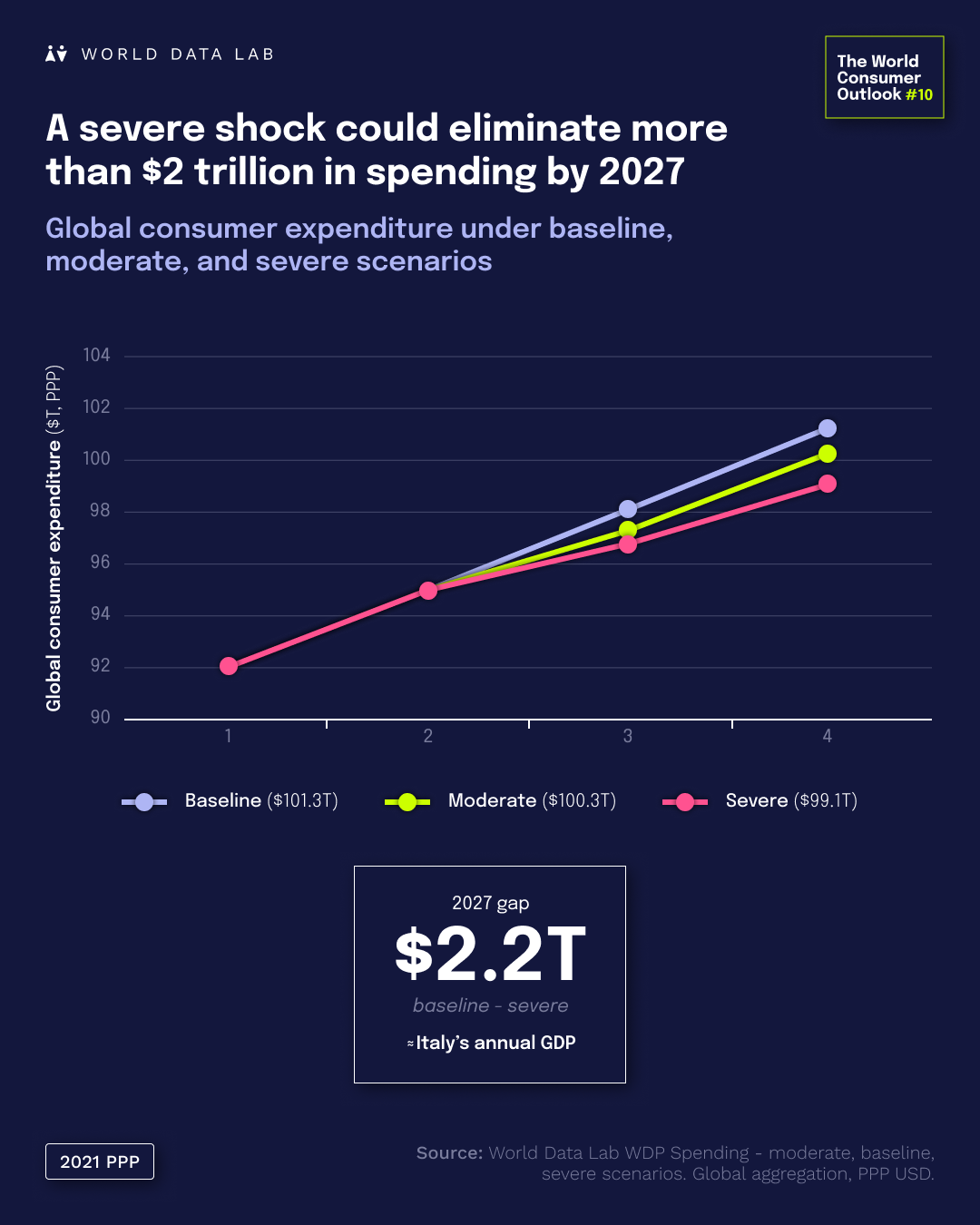
The key risk is a more severe and prolonged shock. If oil prices remain elevated above $120 per barrel, new consumer class entrants in 2026 could fall to just 72 million, 40 million fewer than the baseline, and the weakest year since the turn of the millennium, with the sole exception of 2020. At that level, $2.2 trillion in consumer spending would be lost, roughly Italy's entire annual GDP. The country most exposed is India, which alone could see 20 million people held back from the consumer class, twice as many as any other country. The poorest people, who spend the highest share of their income on food and fuels, will be hit the hardest, as will developing economies already struggling under heavy debt burdens.
Whatever the trajectory of the shock, World Data Lab points to a structural shift in global consumer growth that will define the decade ahead. Asia already drives 79% of new consumer class entrants, and the gap with the West is widening: between 2025 and 2030, Asia's middle-class population is set to grow 18% while affluent spending in the West grows 15%, two diverging trajectories that demand fundamentally different strategies from any business with global ambitions.
About World Data Lab
World Data Lab is a global consumer intelligence enterprise that tracks and forecasts spending behavior across 190 countries. Its proprietary datasets cover 7000+ cities, income distribution, consumer class transitions, and generational spending shifts.
Accompanying high-resolution graphs are available in the media kit.
Media Contact: Anne Mason | anne.mason@worlddatalab.com
Anne Mason
World Data Lab
anne.mason@worlddatalab.com
After the Oil Shock
Legal Disclaimer:
EIN Presswire provides this news content "as is" without warranty of any kind. We do not accept any responsibility or liability for the accuracy, content, images, videos, licenses, completeness, legality, or reliability of the information contained in this article. If you have any complaints or copyright issues related to this article, kindly contact the author above.
