

Samaritan Expands Vigil With Monitor, Research, Report, and Respond Workflow
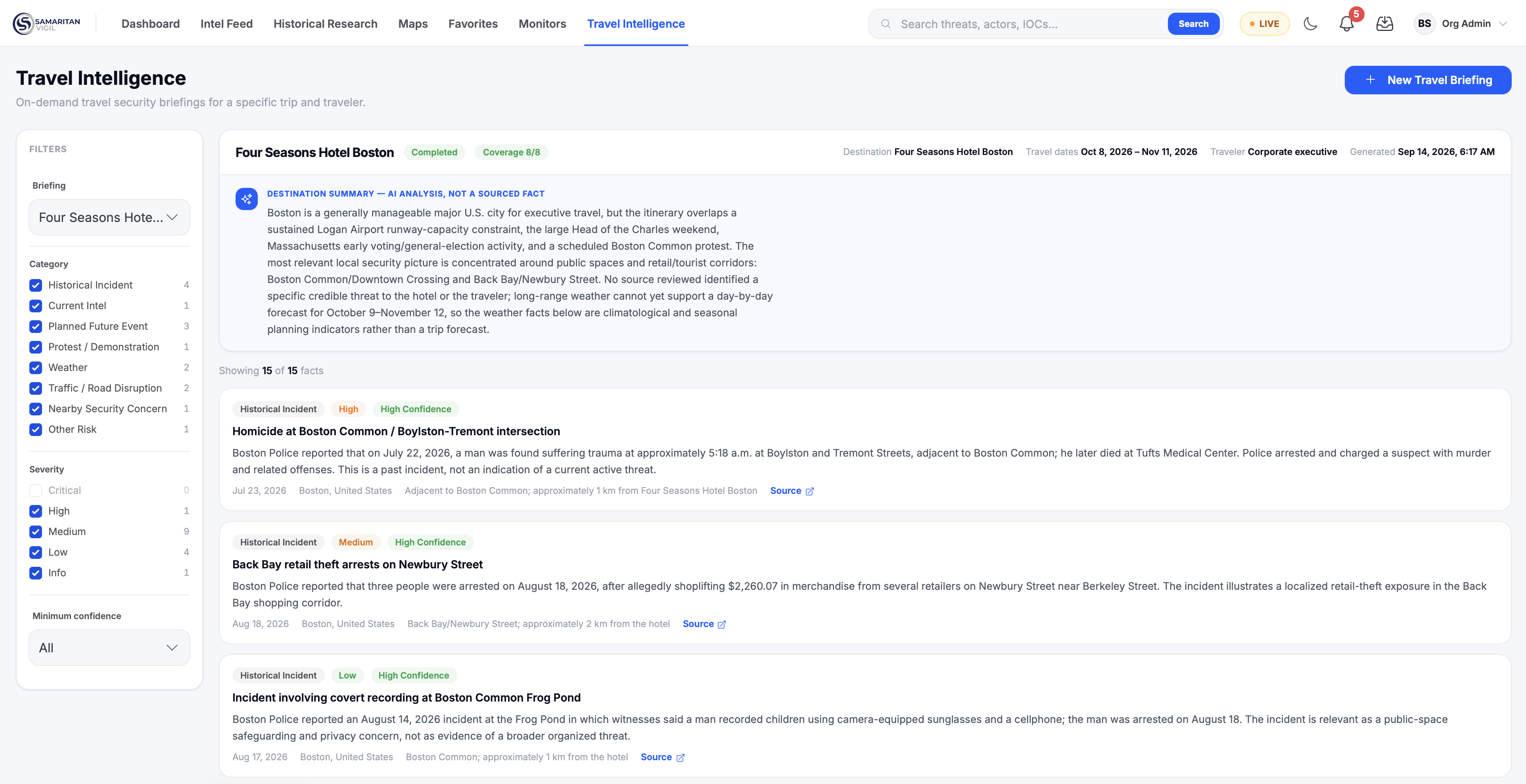
Travel Risk Management

Samaritan Vigil Logo
Vigil’s expanded workflow helps security teams move from risk monitoring to research, reporting, and informed operational response.
WASHINGTON, DC, UNITED STATES, September 27, 2026 /EINPresswire.com/ -- Samaritan has announced updates to Samaritan Vigil™, expanding the protective intelligence platform’s focus beyond risk monitoring to support a broader operational workflow: monitor, research, report, and respond. The new features were released in time for Global Security Exchange (GSX), where Samaritan demonstrated the platform during its first exhibition at the event.The expanded approach reflects the work security teams undertake after identifying a potentially relevant development. An alert begins a process that may require further research, an assessment of operational significance, communication with stakeholders, and a decision about how to respond. Samaritan is positioning Vigil around that full sequence, connecting awareness with the work needed to inform action.
Samaritan CEO Brandon Shafikhani described the platform’s evolution as moving beyond monitoring alone toward a more complete protective intelligence workflow. The emphasis is on helping professionals carry information through successive stages of review and decision-making while keeping the underlying operational requirement in focus.
Monitor: Establish awareness around the assignment
Protective intelligence begins with a clear understanding of what needs protection and which developments could affect it. For a security team, that requirement may involve an executive’s movements, a corporate location, an upcoming event, or a travel destination.
Vigil’s published capabilities include configurable monitors, open-source information, weather information, map visualization, AI-generated summaries, and alerts. These capabilities provide a foundation for reviewing developments in relation to the people, places, and topics a team follows.
The monitoring stage establishes the starting point for further work. A development near a destination, for example, may merit attention because of its timing, proximity, or possible effect on an itinerary. Its significance depends on the assignment and the circumstances surrounding it.
Vigil’s broader workflow places that initial awareness within a continuing process of assessment, communication, and response.
Research: Determine what a development means
Once information attracts attention, the next task is to understand it. Security professionals need to examine the available material, consider its relevance, and distinguish what is established from what remains uncertain.
Research gives an initial signal operational context. Questions may include whether a development affects a planned movement, whether additional sources support an account, how current the information is, and whether circumstances are changing.
Within Samaritan’s monitor, research, report, and respond framework, this stage connects the discovery of information with the assessment needed to use it responsibly. The objective is to help teams develop a clearer understanding of a concern before communicating conclusions or recommending action.
A structured research process also helps define what requires continued attention. Some developments may justify immediate escalation; others may warrant additional monitoring as more information becomes available.
Report: Communicate findings for a decision
Intelligence becomes useful to a wider organization when its meaning can be communicated clearly. A protection lead, corporate security manager, event organizer, or operational stakeholder may need different levels of detail, but each needs to understand why the information matters.
The reporting stage of Vigil’s expanded workflow emphasizes that transition from research to communication. An effective assessment explains the relevant development, its possible implications, the uncertainties that remain, and the decisions it may inform.
For security teams, this can mean framing findings around a specific assignment rather than presenting information without context. A travel-related assessment, for example, should make clear which part of a journey could be affected and what further review may be appropriate.
Samaritan’s approach places reporting within the intelligence process, connecting what a team has learned with the people responsible for deciding what happens next.
Respond: Inform operational action
The response stage brings the workflow back to the protective mission. Depending on the circumstances, a response could involve reviewing a route, adjusting a schedule, briefing personnel, coordinating with a local contact, or maintaining observation while a situation develops.
These examples illustrate the decisions protective intelligence can inform. The appropriate action remains dependent on the organization’s procedures, available resources, and professional judgment.
By including response in Vigil’s broader framework, Samaritan is emphasizing the practical purpose of intelligence work: supporting decisions about the protection of people and operations.
Response also creates new information requirements. After a team adjusts a plan, it may need to monitor a different location, research an alternative destination, or update stakeholders. The four stages therefore form a continuing process that can evolve with the assignment.
Demonstrated to security professionals at GSX
Samaritan’s UK Director, Andrew Bellman, and Vigil’s Program Manager, Sarah Cummings, provided live demonstrations to prospective and existing clients at GSX. The sessions introduced features released in time for the exhibition and gave attendees an opportunity to discuss the platform with the team.
The demonstrations provided a setting for exploring Vigil’s expanded direction through conversations about operational needs. Following the event, Samaritan is continuing discussions with interested organizations and arranging further demonstrations.
Vigil serves executive protection, corporate security, event security, and travel risk professionals. Its combination of monitoring, intelligence feeds, summaries, maps, and mobile access supports awareness across office and field environments.
Organizations evaluating the platform can request a demonstration focused on their requirements and ask the product team to walk through the current capabilities supporting each stage of the monitor, research, report, and respond workflow.
For more information or to schedule a demonstration, visit samaritanps.com/platform/vigil.
About Samaritan
Samaritan provides security, risk management, and intelligence services, including protective services, risk advisory, technical security countermeasures, and protective intelligence. Its Samaritan Vigil™ platform supports professionals responsible for protecting people, places, events, and operations. The company combines its security services with technology intended to support informed operational decisions.
Sarah
Cummings
+1 866-906-2334
email us here
Visit us on social media:
LinkedIn
Legal Disclaimer:
EIN Presswire provides this news content "as is" without warranty of any kind. We do not accept any responsibility or liability for the accuracy, content, images, videos, licenses, completeness, legality, or reliability of the information contained in this article. If you have any complaints or copyright issues related to this article, kindly contact the author above.
