

Syntharis Group: Brand Mentions Matter More Than Backlinks in AI Search
Brand Mentions AI Visibility
The free guide of more than 200 pages explains why independent brand mentions and consistent company data shape who gets named in AI answers.
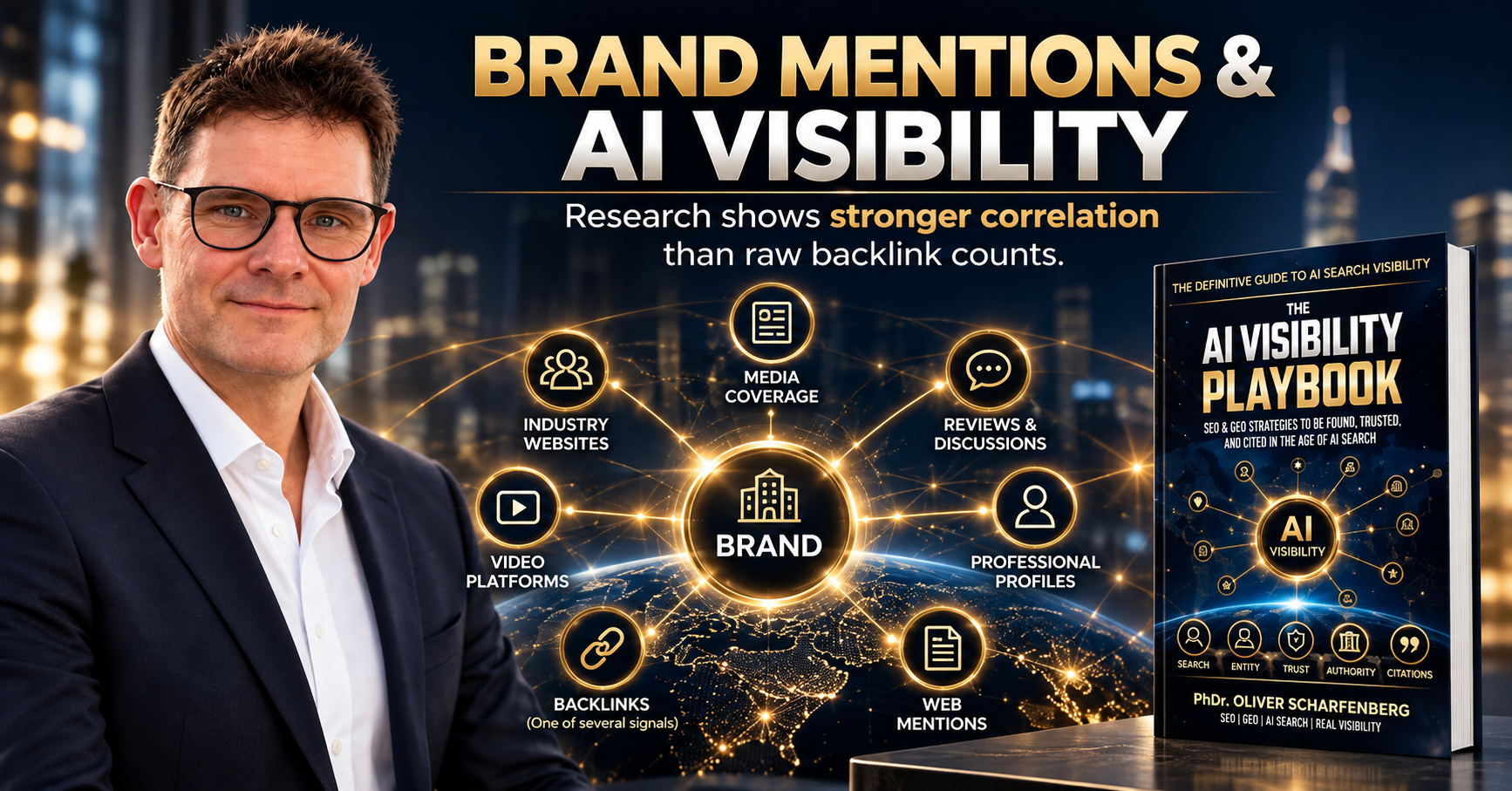
DUBAI, DUBAI, UNITED ARAB EMIRATES, September 30, 2026 /EINPresswire.com/ -- For twenty years, backlinks were the main currency of SEO. In AI answers, brand mentions seem to count for more. That is one of the central points in The AI Visibility Playbook by PhDr. Oliver Scharfenberg, founder of the Dubai consultancy Syntharis Group, which advises companies on AI visibility. The book runs to more than 200 pages and is now available as a free download at www.syntharis.group.Much of the evidence comes from Ahrefs. In a study of 75,000 brands, the SEO software company measured how often each brand was named across the web and compared that with its presence in Google's AI Overviews. The correlation was 0.664. For backlinks it was 0.218, about three times weaker. A follow-up study that added ChatGPT and Google's AI Mode found YouTube mentions to be the strongest single signal. Scharfenberg is careful to call this a correlation rather than proof. Still, the pattern holds: brands that people discuss in independent articles, reviews and communities are more likely to turn up in AI answers.
'An AI system names the companies it can identify with confidence,' said Scharfenberg, founder and CEO of Syntharis Group. 'If your website gives one founding year, LinkedIn another and some directory a third, the machine has good reason to leave you out. Consistency is boring work. It is also what decides who gets named.'
The book calls this entity SEO, or building entity authority. An entity is a company, person or product that a machine can tell apart from others with similar names. The practical advice is to write one master description of the company, with official name, category, a one-line summary, founding details, key people and official links, and to use exactly that wording on the website, on LinkedIn, Crunchbase and Google Business Profile, in the site's structured data and on Wikidata where the notability rules allow an entry.
Off the website, the playbook swaps the classic content calendar for an evidence calendar. Instead of a set number of blog posts, a company adds one piece of proof each month. That might be a methodology page, a small benchmark study, a fair comparison with the main competitor, an expert interview, a client case with real numbers, or a listing on the review sites and in the comparison articles that AI systems read. Digital PR, seen this way, is less about reach and more about leaving a trail of brand mentions that machines can check.
Scharfenberg's own research shows why that check matters. In a randomized experiment with 1,093 participants, carried out with the Deutsches Institut für Qualitätsstandards und -prüfung (DIQP), a credible employer seal on a job ad raised the share of people likely to apply from 38 to 54 percent. The effect only held when the seal rested on transparent criteria and real verification. Bought badges and advertorials dressed up as news, the book argues, do nothing for a brand's standing with readers or with AI systems.
'Authority is something others give you,' Scharfenberg said. 'The job is to make that recognition visible and easy to check.'
Syntharis Group supports companies in building this public record, from a consistent entity profile to earned media coverage and review presence. The playbook, with an entity profile template and a twelve-month evidence calendar, is free to download at www.syntharis.group.
Oliver Scharfenberg
Syntharis Group FZCO
email us here
Legal Disclaimer:
EIN Presswire provides this news content "as is" without warranty of any kind. We do not accept any responsibility or liability for the accuracy, content, images, videos, licenses, completeness, legality, or reliability of the information contained in this article. If you have any complaints or copyright issues related to this article, kindly contact the author above.
